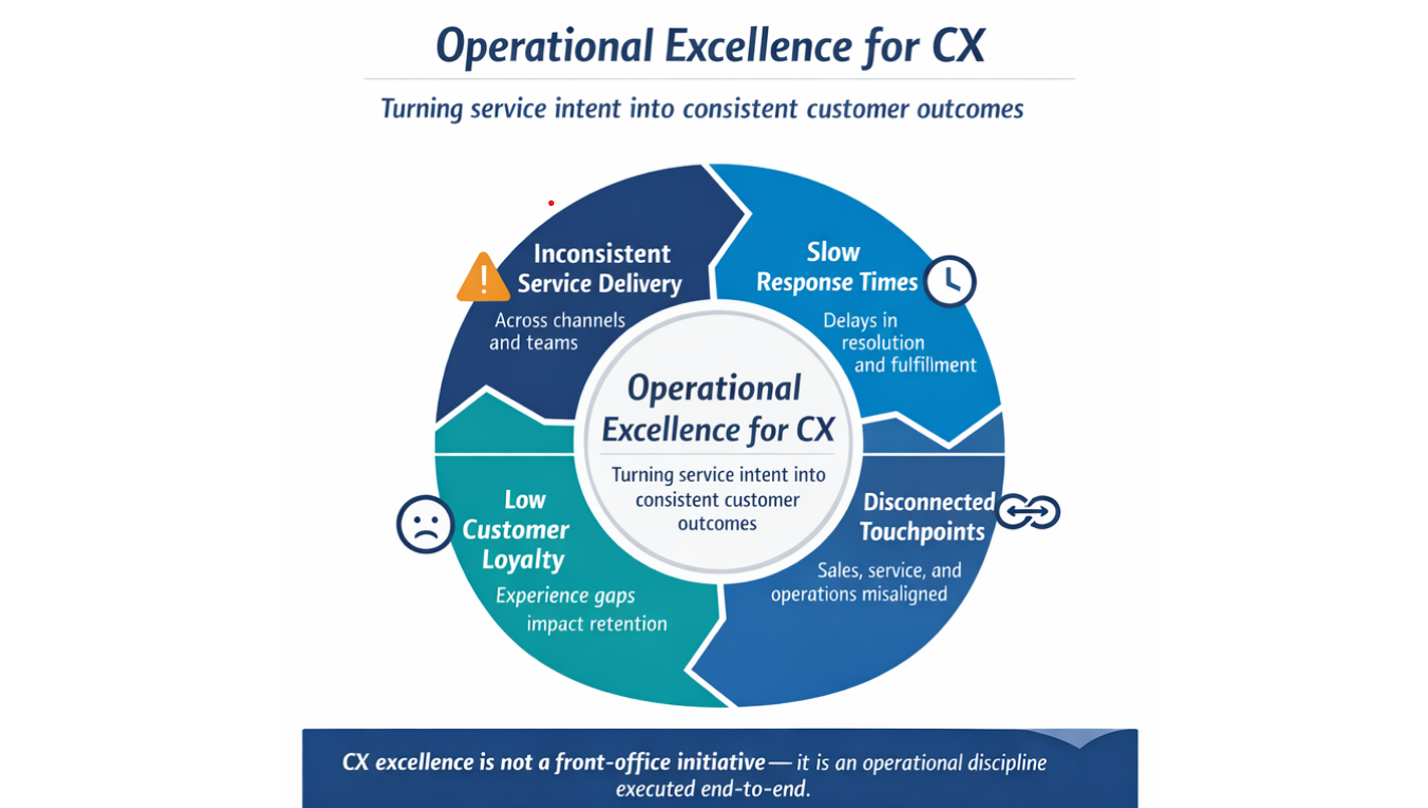
Sustainable competitive advantage is no longer created through strategy alone—it is built through operational excellence, strong leadership execution, and continuous operational transformation.
In modern business consulting, organizations that outperform their peers do so by aligning strategy with day-to-day operations, embedding performance discipline, and enabling leaders to convert intent into measurable outcomes. Operational excellence has therefore become a core driver of profitability, scalability, and long-term resilience.
Operational excellence has evolved from a cost-reduction initiative into a strategic business imperative. Organizations that consistently outperform their peers do so not because they work harder, but because they operate smarter—aligning people, processes, and performance metrics to strategic goals. This is where operational transformation, supported by strong leadership and execution-focused consulting, becomes a decisive differentiator.
At Syncore Consulting, operational excellence is not treated as a theoretical concept. It is implemented as a measurable, results-driven transformation program that delivers sustainable improvements in efficiency, profitability, and organizational capability.
Why Operational Excellence Is a Strategic Imperative Today
Modern enterprises face increasing complexity across supply chains, customer expectations, regulatory compliance, and talent management. Many leadership teams struggle with challenges such as:
- Rising operational costs despite revenue growth
- Inconsistent execution of strategy at the ground level
- Poor cross-functional coordination
- Lagging KPIs despite multiple improvement initiatives
Operational excellence addresses these challenges by embedding execution discipline into the organization. Rather than chasing isolated efficiency gains, it creates a system where performance improvement becomes continuous, measurable, and scalable.
From a business consulting perspective, operational excellence is powerful because it directly links strategy to outcomes—turning leadership intent into operational reality.
Core Principles of Operational Excellence
Operational excellence is not achieved through tools alone. It is built on a set of foundational principles that guide leadership behavior, decision-making, and execution.
1. Eliminating Waste, Maximizing Value
Lean principles focus on identifying and eliminating non-value-adding activities across processes. Waste—whether in the form of excess inventory, rework, delays, or unnecessary approvals—directly erodes competitiveness.
Key outcomes include:
- Shorter cycle times
- Improved process efficiency
- Higher customer satisfaction
- Reduced operational costs
In operational transformation programs, Lean serves as the foundation for process simplification and flow optimization across manufacturing, services, and support functions.
2. Theory of Constraints (TOC): Fixing What Limits Growth
The Theory of Constraints helps organizations identify the single most critical bottleneck that limits system performance. Instead of spreading improvement efforts thin, TOC focuses leadership attention on the constraint that delivers the highest business impact.
Typical applications include:
- Production throughput improvement
- Sales pipeline optimization
- Project delivery acceleration
For leadership teams, TOC provides clarity—ensuring that operational decisions are aligned with enterprise-level performance, not local optimization.
3. Continuous Improvement: Building a Performance Culture
Operational excellence is not a one-time initiative. It requires a culture of continuous improvement where teams are empowered to identify problems, solve them systematically, and sustain gains.
Key elements include:
- Standardized problem-solving methods
- Data-driven decision-making
- Leadership coaching and accountability
- Transparent performance dashboards
This principle is where leadership transformation becomes critical. Without leadership commitment, improvement efforts fail to sustain beyond initial gains.
Leadership's Role in Operational Transformation
Operational excellence cannot be delegated. It must be led from the top.
Leadership teams play a defining role in:
- Setting clear performance expectations
- Aligning strategy with operational priorities
- Reinforcing accountability through KPIs
- Role-modeling disciplined execution
In many consulting engagements, the gap is not technical capability but leadership alignment. Syncore’s business consulting approach explicitly integrates leadership development with operational execution, ensuring transformation is owned—not outsourced.
Real-World Impact: Operational Excellence in Action
Case Example 1: Manufacturing Cost Reduction and Throughput Improvement — Results: 18% reduction in operating costs, 25% increase in throughput, improved on-time delivery from 82% to 96%.
Case Example 2: Sales and Operations Alignment for Revenue Growth — Results: 30% improvement in forecast accuracy, reduced revenue leakage, stronger collaboration across leadership teams.
Real-World Impact: Operational Excellence in Action
Case Example 1: Manufacturing Cost Reduction and Throughput Improvement
A mid-size manufacturing organization faced declining margins despite steady demand. Multiple improvement initiatives had been launched, but results were inconsistent.
Syncore Consulting's intervention included:
- End-to-end value stream mapping
- Identification of production constraints using TOC
- Lean process redesign
- KPI realignment at shop-floor and leadership levels
Results:
- 18% reduction in operating costs
- 25% increase in throughput
- Improved on-time delivery from 82% to 96%
More importantly, the organization developed internal capability to sustain improvements beyond the consulting engagement.
Case Example 2: Sales and Operations Alignment for Revenue Growth
A B2B services company struggled with forecast accuracy, missed revenue targets, and internal friction between sales and operations.
Operational transformation initiatives included:
- Redesign of sales-to-delivery processes
- KPI alignment across departments
- Leadership workshops focused on cross-functional execution
- Performance cadence reviews
Results:
- 30% improvement in forecast accuracy
- Reduced revenue leakage
- Stronger collaboration across leadership teams
This engagement demonstrated how operational excellence directly supports strategic growth objectives.
Syncore's Framework for Sustained Operational Excellence
1. Diagnose: Linking Strategy to Operational Reality
2. Design: Co-Creating Practical Solutions
3. Execute: Driving Measurable Performance Improvement
4. Sustain: Embedding Capability and Accountability
Conclusion
In an era where strategies are easily replicated, execution excellence becomes the ultimate differentiator. Operational excellence—anchored in strong leadership, disciplined execution, and continuous improvement—allows organizations to convert ambition into performance.
Syncore Consulting's approach to operational transformation is built on one principle: results matter. By aligning leadership, processes, and KPIs, Syncore helps organizations not just improve—but sustain competitive advantage in the long run.